
Why this church has begun celebrating the Lord’s Supper every week: because the way we experience communion shapes how we grow as disciples of Jesus.
There was a young girl who came forward to receive Holy Communion. But she was disappointed by the tiny piece of bread she was given, and she said loudly, “I want more! I want more!” Her parents may have been embarrassed, but that little girl was onto something.
Many of us have spent our whole lives in the church, hearing the sermons, singing the songs, being read the scriptures. And sometimes we can start to think that that’s all there is to it. That we are simply consumers of the services of the church. I need to show up, sit here, and agree with everything that’s true. Obviously if the preacher says or does something I don’t like, that’s different. They’re changing the product, and I don’t like it.
We are used to thinking in terms of faith, using the Christian words correctly. We know how to talk like disciples of Jesus. But we are not always used to acting in faith, to taking actions that affirm and declare that same real, influential faith. To being people who live in the reality of Jesus’ presence.
But here’s something I’ve seen and continue to witness: we are hungry to be the people we say we are. We want to grow in Christ, we want to be deeper people, standing firm in our confidence in Christ and his call upon us.
So, this is not the sermon I initially planned to preach this Sunday, but maybe it should have been. Maybe I should have preached it even earlier. Because I know that some of you are uncomfortable with the fact that we have begun celebrating the Lord’s Supper every week, and I want to help us understand why we are doing this. Because it’s not simply a matter of preference. It’s not that I just like doing it this way, or that I want to be different. I fundamentally believe that the way we experience communion, and for that matter, the actions we take in worship influence how we grow as disciples of Jesus. It’s not the only factor, for sure, but it is an important one.
Taking communion more frequently than once a month is not a new idea. At a previous church, I remember a man coming up to me and saying, “I guess a lot of churches are just starting to do communion every week now. I guess the old way isn’t good enough anymore.” It honestly hurt my heart to hear him say that, because I never want the celebration of the Eucharist to be something that stirs bitterness or anger. But his words also showed that he thought that “what I’m used to” is the same as “the old ways,” or tradition, or the “right” way.
In fact, John Wesley, the founder of the Methodist movement in the 1700s, believed and taught that the Lord’s Supper is “the grand channel whereby the grace of [God’s] Spirit [is] conveyed to the souls of all the children of God.” He believed that partaking of the consecrated bread and drink from the Lord’s table is one of the most reliable means, or channels, through which followers of Jesus receive and are transformed by God’s grace. And like most Christians in the early centuries of the church, Wesley himself usually took communion four or five times per week.
His most well-known sermon on the practice of the Lord’s Supper, in fact, is called The Duty of Constant Communion, and it emphasizes the important place that this sacramental practice has in our lives. In that sermon, he says that the only things required for a person to receive communion are these: “A full purpose of heart to keep all the commandments of God, and…a sincere desire to receive all his promises.”
So what is communion, anyway? What does it mean, and why do we do it? That has been a question that Christians have asked for as long as there have been Christians, and there have been several different ways that different traditions have answered it.
In our tradition, in the Methodist tradition, we believe that it is more than a memorial for Christ’s death and resurrection. It is that, but it is also more. The official teaching on the meaning of Holy Communion in the UMC, which is titled This Holy Mystery says this: “In accord with biblical and Christian teaching, we believe that we are sinners, constantly in need of divine grace. We believe that God is gracious and loving, always making available the grace we need. Grace is God’s love toward us, God’s free and undeserved gift.” It goes on to say that “In a sacrament (meaning communion and baptism), God uses tangible, material things as vehicles or instruments of grace.”
So we are reminded that God’s grace is not simply a vague idea, an abstract notion, but an actual expression of God’s reality, a present force, if you will, of transformation. And there are, in our lives, what John Wesley called “means of grace.” There are certain experiences and practices which reliably shape us into more fully formed disciples of Jesus. Those means of grace are: “The public worship of God. The ministry of the Word, either read or expounded. The Supper of the Lord. Family and private prayer. Searching the Scriptures. Fasting…” as well as “edifying conversation and meeting together in groups for nurture and accountability.”
These regular, ordinary practices are like a whetstone for our souls. They are not magic. But as we do them over and over, as we practice communion, prayer, hearing scripture, fasting, with the intention of growing deeper in Christ, we are sharpened. And so I want us to come to the table of God’s grace as often as we can. Because we need to be sharp. We need to be always growing deeper in faith.
So you see, we cannot be, we are not meant to be, Christ does not call us to be consumers of religious services. We’re not here to take what we can get out of church and go about our week. We gather in worship to tell a story, a story we’re part of. It’s the story of God with us, the creator of the cosmos, the one who rescues us all, the one who brings meaning and purpose into the world. We are not the main characters in the story. But we are in it, each of us with a role and a purpose.
We are servants in the kingdom of Christ, under his authority, and loyal to his rule. We are children in God’s household, cared for and provided for and taught by a loving parent. We are the harvest of God’s fields, grown and nurtured by the spirit of God so that we might grow and nurture others.
And as we share in that mission, to nurture others, we are constantly reminded at Christ’s table that he has made a place of belonging for us, not because we deserve it, but because Christ wants us near him, with him. And there is room at his table for anyone and everyone.
The more we are able to embrace the holy mystery of God’s grace, which is present with us in a real way, at the communion table, in the bread and in the drink, the deeper we can grow as God’s people, as individuals called into community to love and serve our Creator, Redeemer, and Sustainer. The deeper our sense of identity as Christ’s people, nourished by his body and blood, by the bread of heaven, by the spring of everlasting life. As This Holy Mystery, the church’s teaching on communion says, “[Our] life in union with Christ is life eternal. It is not only the promise of our being with Christ after physical death. It is also our being in dynamic loving relationship with Christ here and now. It is life that never ends because it is grounded in the everlasting love of God who comes to us in [communion].”
More News

Weekly Update
September 4, 2026
This Week at a Glance
Ministry Spotlight
September 4, 2026
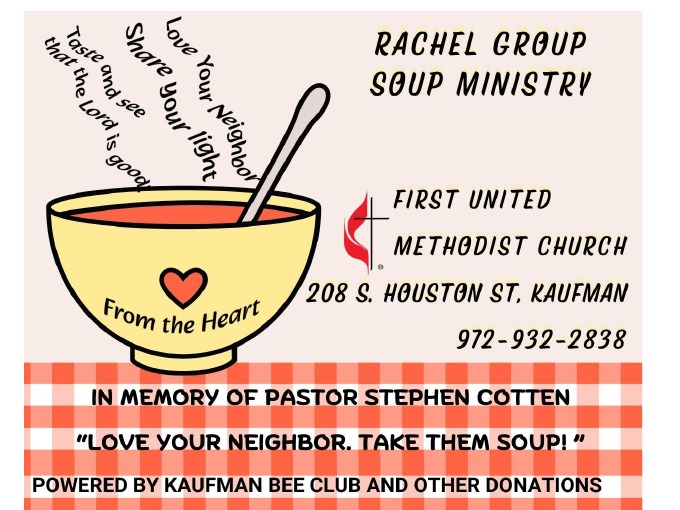
Meals on Wheels & the From the Heart Soup Ministry
By Pam Caffey
Christian Education
September 4, 2026
Sunday School & Bible Study Opportunities