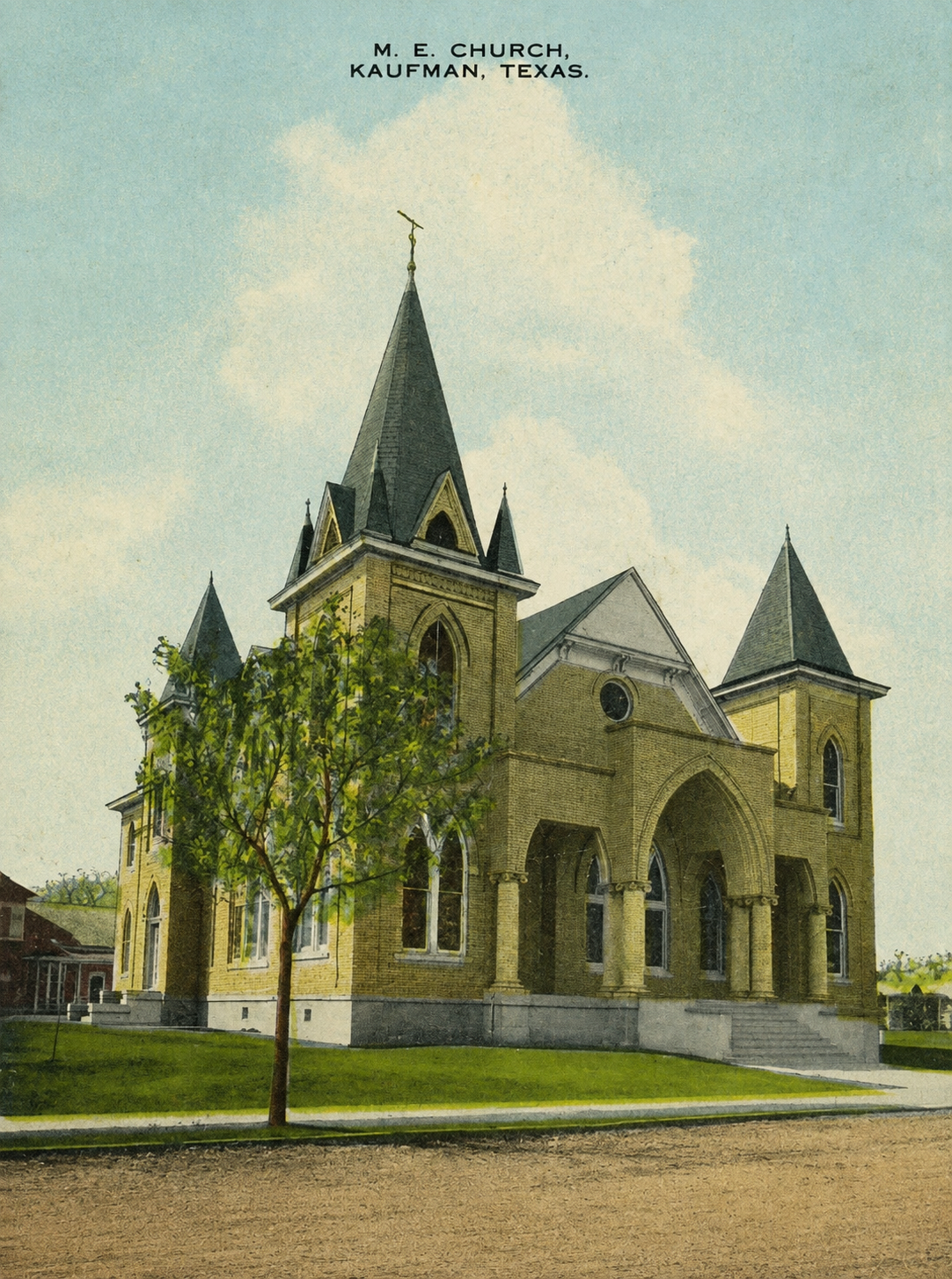
Our History
Nearly two centuries of faith in this community.
Organized in February 1845 as the Kingsborough Methodist Episcopal Church, South, our congregation has worshiped in Kaufman for more than 180 years, through a name change, three sanctuaries, and dozens of pastors.
1845: A Congregation Is Organized
In February of 1845, a small group of Methodist families gathered to organize the Kingsborough Methodist Episcopal Church, South, under the leadership of its first pastor, the Rev. Wm. K. Wilson. The town itself, and its Methodist congregation, would not carry the name Kaufman for another five years.
1850: Kingsborough Becomes Kaufman
In 1850, Kingsborough, then the Kaufman County seat, was renamed Kaufman in honor of Congressman David Spangler Kaufman. The congregation carried its founding name forward with the town.
1857-1876: Building A Permanent Home
The present church site was purchased and the congregation's first building erected in 1857, with the Rev. J. A. Scruggs serving as pastor. Nearly two decades later, in 1876, a second, traditional steepled, white frame structure replaced it at a cost of $400, under the Rev. O. P. Thomas.
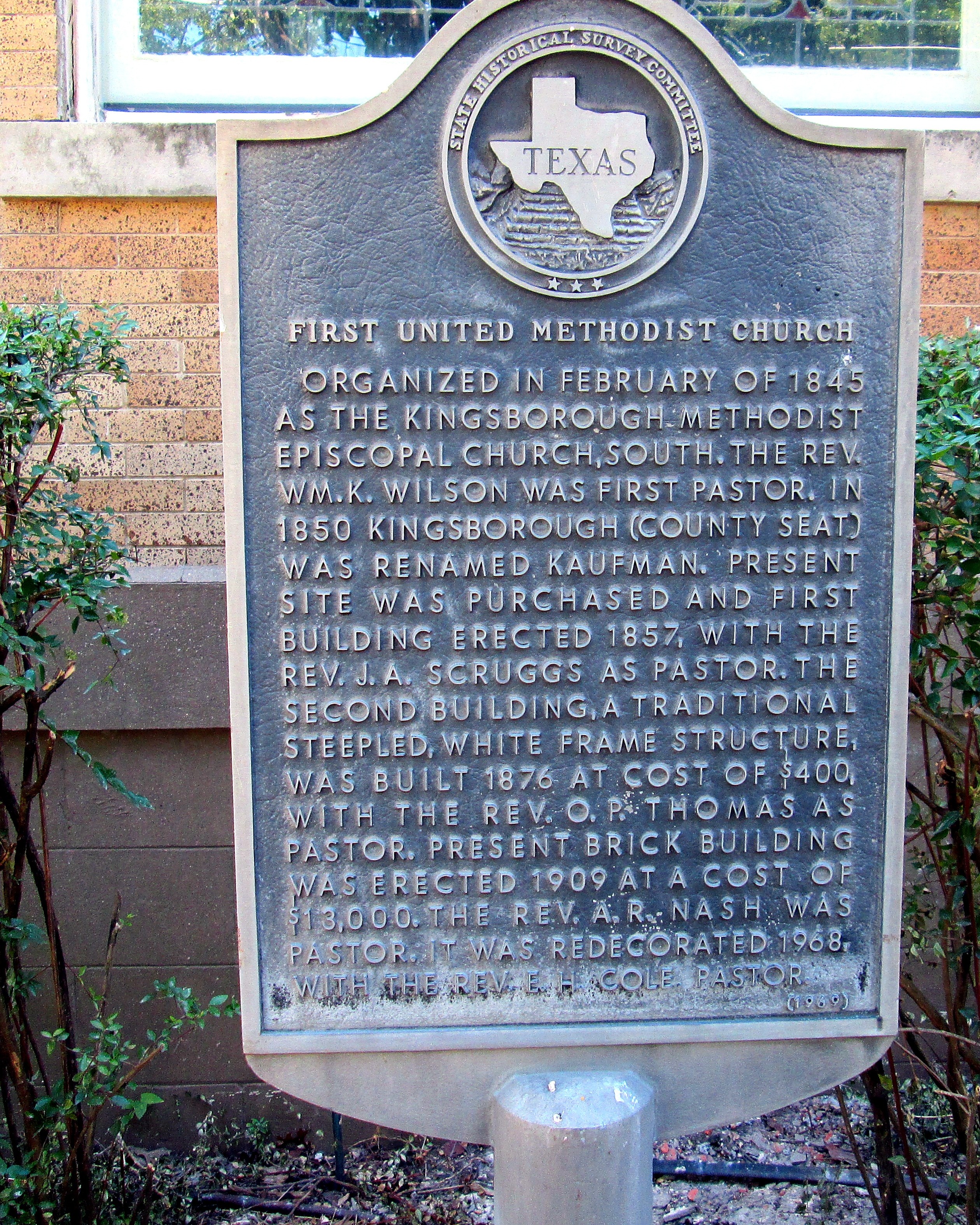
Organized in February of 1845 as the Kingsborough Methodist Episcopal Church, South. The Rev. Wm. K. Wilson was first pastor. In 1850 Kingsborough (county seat) was renamed Kaufman. Present site was purchased and first building erected 1857, with the Rev. J. A. Scruggs as pastor. The second building, a traditional steepled, white frame structure, was built 1876 at cost of $400, with the Rev. O. P. Thomas as pastor. Present brick building was erected 1909 at a cost of $13,000. The Rev. A. R. Nash was pastor. It was redecorated 1968, with the Rev. E. H. Cole, pastor.
Texas Historical Marker, First United Methodist Church of Kaufman — placed by the State Historical Survey Committee, 1969
1909: The Brick Sanctuary We Know Today
The present brick building was erected in 1909 at a cost of $13,000, with the Rev. A. R. Nash as pastor, and our congregation still worships in this building today.
The Organ — $2,600, Raised Mostly at Home
Just behind our choir sits a large brass organ. It was purchased for $2,600, which was a serious sum at the time for a congregation this size. Thanks to a $1,250 donation from the Andrew Carnegie Foundation, which underwrote church organs across the country in the early twentieth century, the congregation was able to raise the rest at home. The church's women's groups collected small amounts through ice cream socials, dinners, recitals, and choir performances.
One of those fundraising dinners was hosted by Mrs. M. O. Spikes, mother of Mrs. Dorsey Brown, in the house known today as the Tom Borders home.
1950s: A Chandelier from the County Courthouse
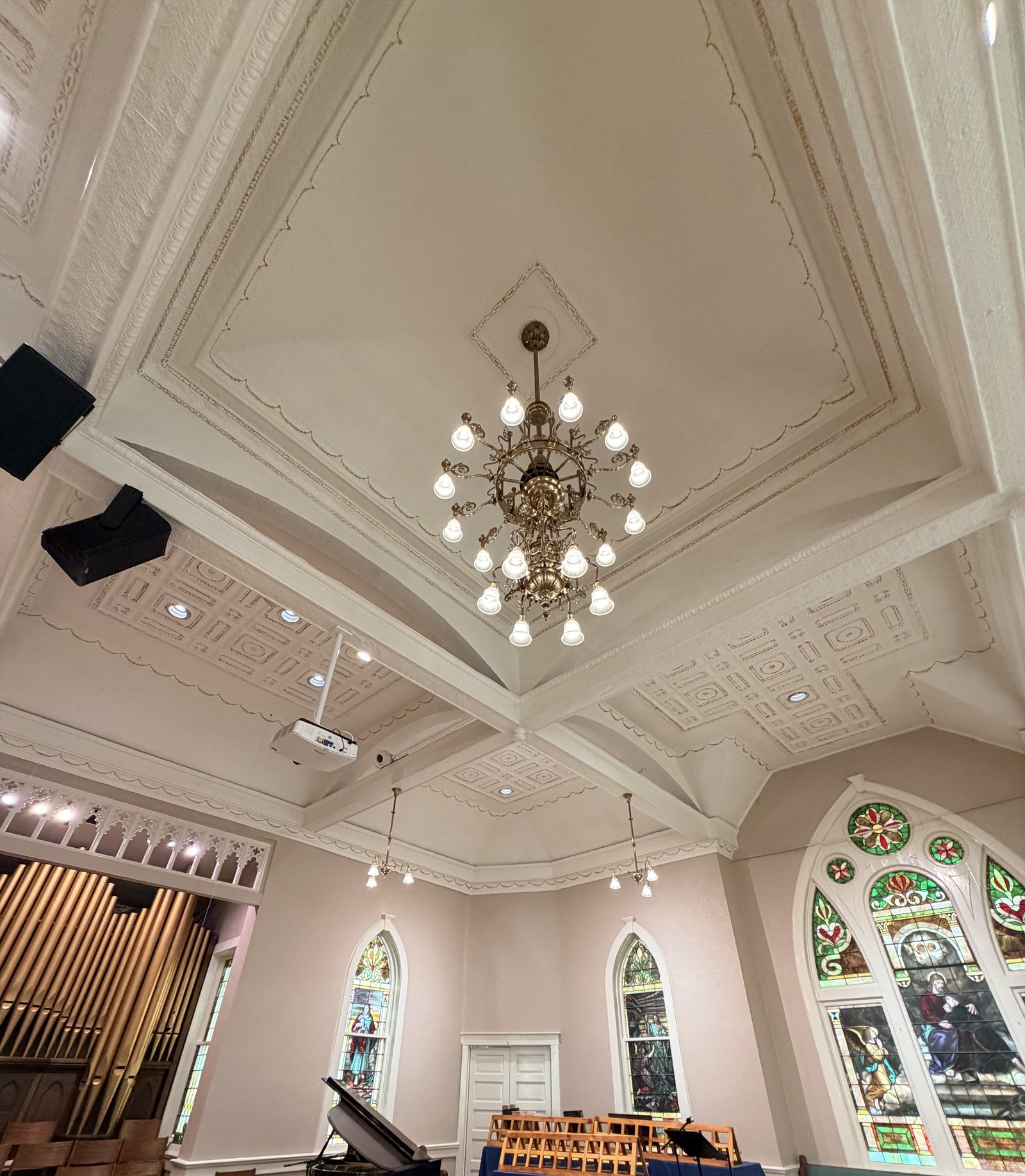
The chandelier hanging in the center of the sanctuary is older than the building it hangs in. It was installed in the Kaufman County Courthouse when that building went up in the late 1800s, and it burned gas rather than electricity.
When the courthouse was torn down in the early 1950s, several people asked after the fixture--among them a church member, Mrs. Elizabeth Nash--but were told the only way to get it was at public auction. Ted Hall, the man who demolished the courthouse, bought everything in the sale and took the chandelier back with him to Iowa.
Not long after, Mr. Hall wrote to County Judge Fred Bankhead to say the church could have it. Gordon Stover, a church member who owned Stover's Cleaners, and whose wife taught school in Kaufman, drove to Iowa in a pickup, loaded the fixture into the back, and brought it home.
It did not arrive looking like much. Decades of gas smoke had blackened the finish, and it had gone years without polishing. Betty (Nash) Hendrickson remembers seeing the big, ugly, black metal piece lying on the floor of the Educational Building and being unable to imagine how it could ever be pretty. Mr. Stover took it to Dallas, where it was polished back to its original finish and wired for electricity. It hangs today in the center of the sanctuary, inverted from the way it once hung over the courthouse floor.
1955: The Grand Piano
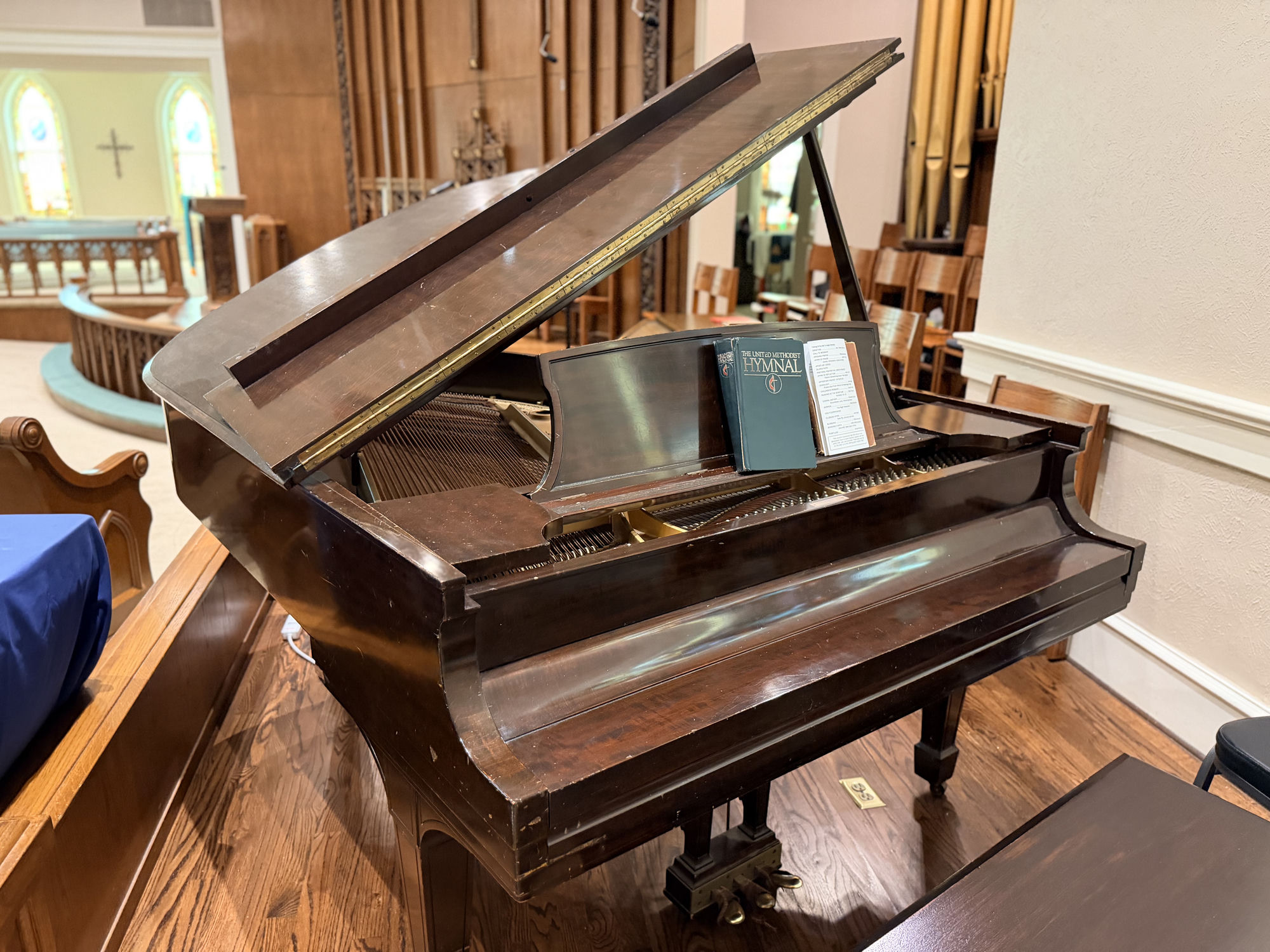
In 1955 the congregation dedicated a newly purchased grand piano in a special service. The Dallas Morning News carried the notice:
The First Methodist Church of Kaufman will dedicate a recently purchased grand piano in a special service … Mrs. J. L. Klinglesmith, president of the Women's Society of Christian Service and Mrs. Arthur Cotton, president of the Wesleyan Service Guild, will present the piano to the congregation.
The Dallas Morning News, 1955
The two women named there led the Women's Society of Christian Service and the Wesleyan Service Guild, the same kinds of organizations that had raised most of the money for the organ a generation earlier. The piano still stands in the sanctuary, a few steps from the organ pipes.
Mid-Century Years
The sanctuary was redecorated in 1968, with the Rev. E. H. Cole serving as pastor.
1985: A Building Restored
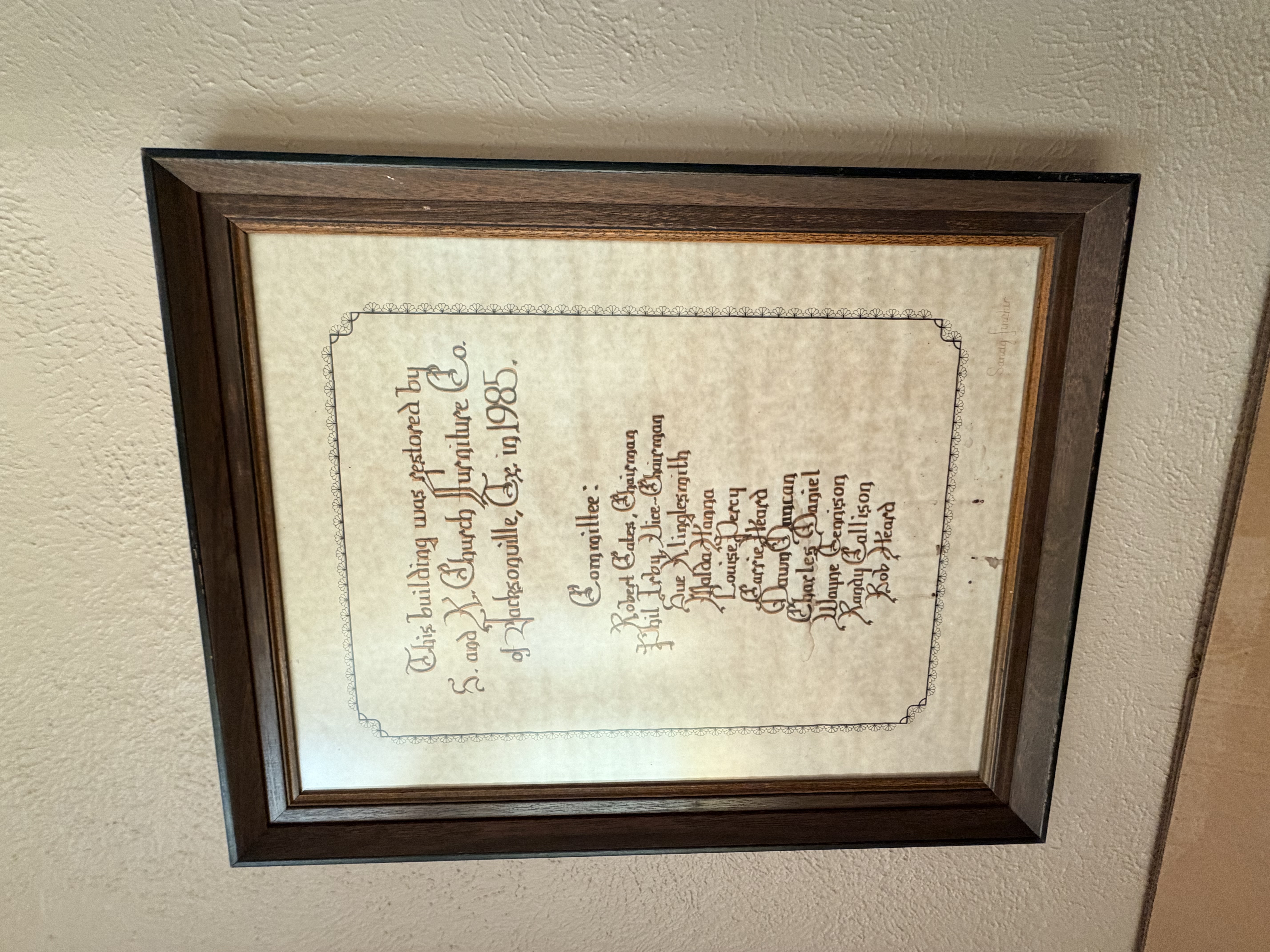
A hand-lettered plaque still hanging inside the church records a later chapter in the building's care.
This building was restored by S. and K. Church Furniture Co. of Jacksonville, Tx. in 1985.
Committee: Robert Cates, Chairman · Phil Irby, Vice-Chairman · Sue Klinglesmith · Malda Hanna · Louise Percy · Carrie Heard · Dawn Duncan · Charles Daniel · Wayne Tennison · Randy Callison · Bob Heard
Restoration dedication plaque, sanctuary
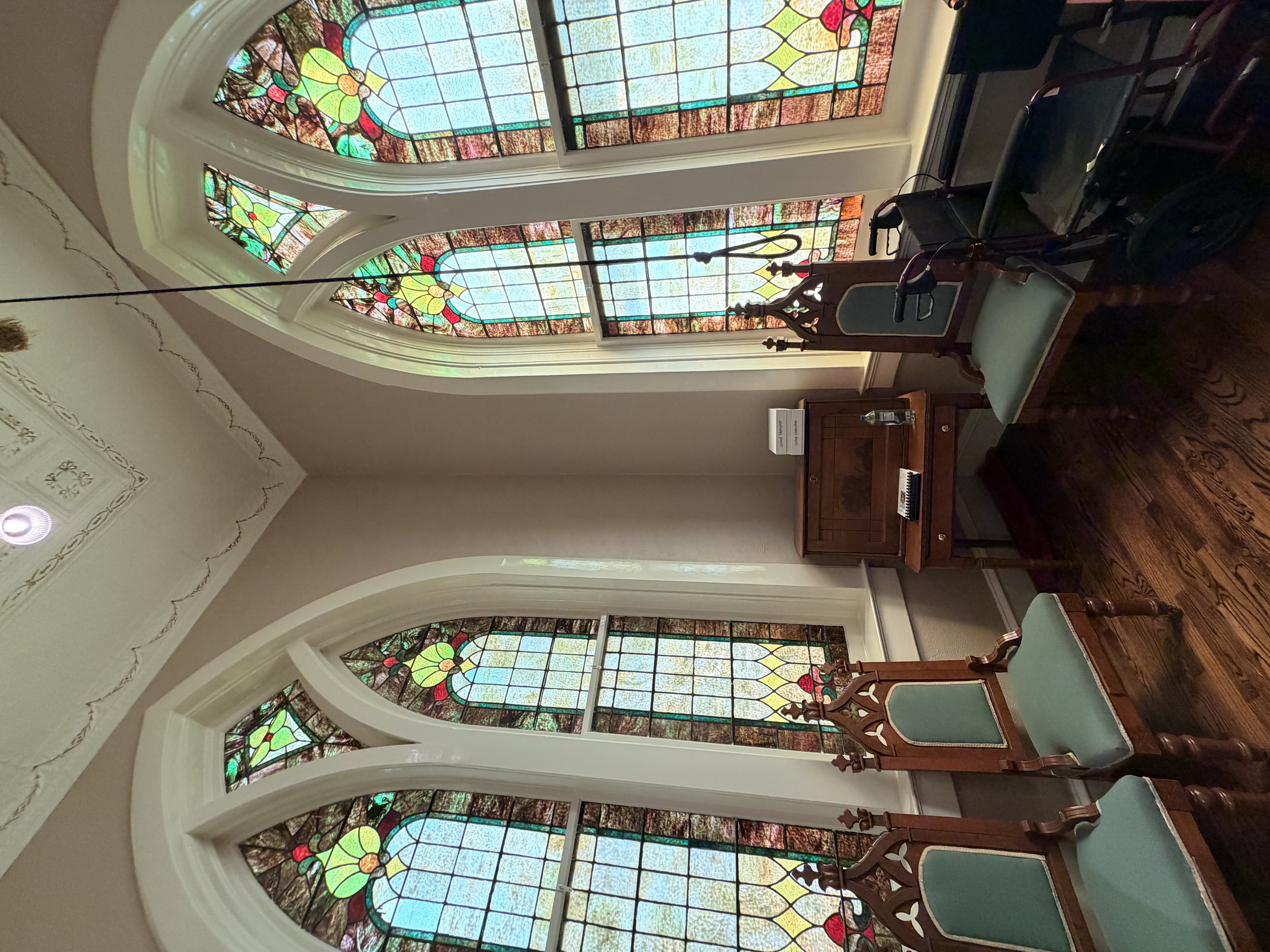
In 1985, the sanctuary was fully restored. In addition to structural work to ensure the building will stand for another hundred years, the pulpit was refinished with wood paneling and the pews were recovered in the light green color scheme we largely still use today.
Today: Continuing the Story
In 2026, the sanctuary walls and ceiling were repainted; the ceiling's gold leaf accents were meticulously refreshed by the same crew that performed the last restoration over 40 years ago.
More Images